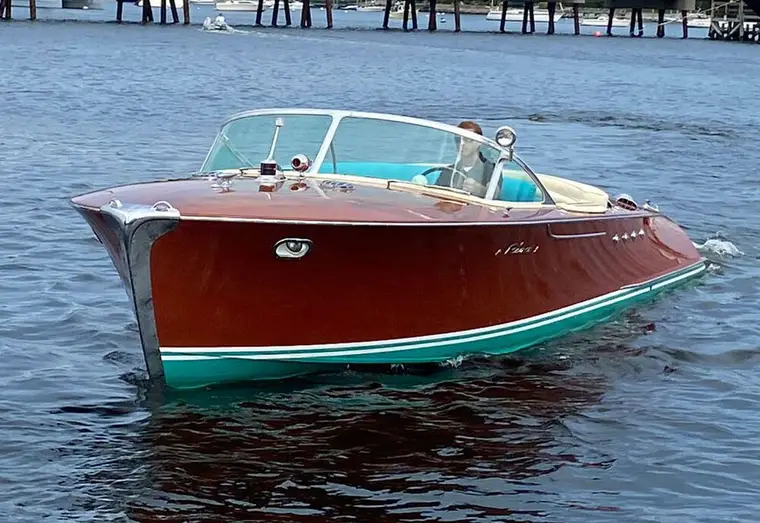
Before the Aquarama, there was the Tritone. Introduced in 1950 alongside the Ariston, it was Riva's large luxury runabout — longer, more powerful and frequently fitted with twin engines. Many collectors consider the Tritone the purest expression of 1950s Riva design, and good examples are increasingly hard to find.
History
The Tritone was built for owners who wanted more space and performance than the Ariston offered, including for use on the open sea. Its twin-engine configuration gave it the power and redundancy that made it popular on the Riviera and the larger Italian lakes. As demand grew for an even more luxurious boat, Riva developed the Aquarama of 1962, which took the Tritone's concept further with a sunbathing deck and panoramic windscreen. Tritone production continued into the 1960s, with an open version and a hardtop variant also built.
Specifications (typical)
| Years | From 1950 into the 1960s |
| Length | about 7.6–8 m (around 25–26 ft) |
| Engines | Single or, more commonly, twin petrol inboards |
| Seating | Two cockpits, up to around 8 people |
| Builder | Riva, Sarnico, Italy |
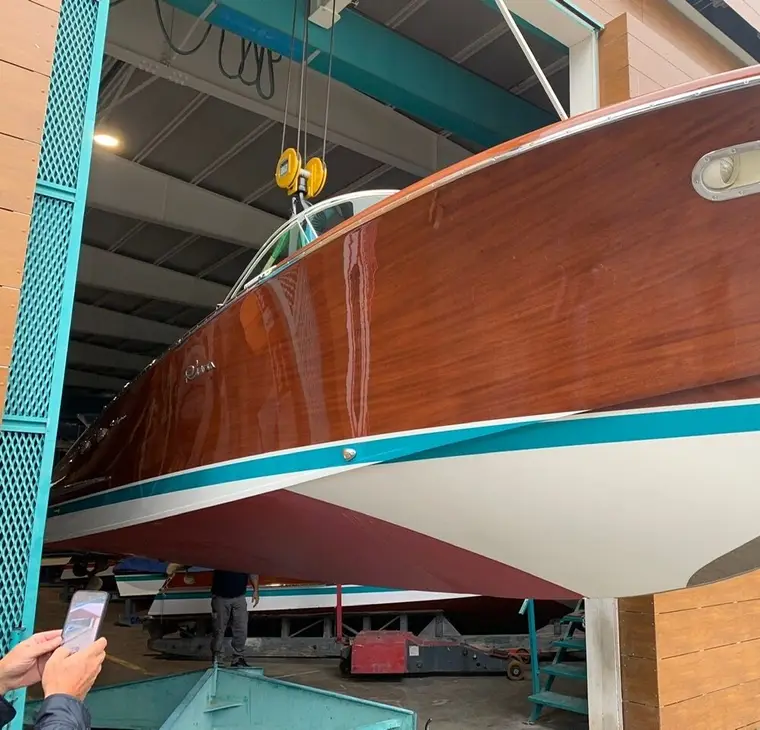
Our current 1958 Riva Tritone is 26.3 ft (8 m) long and comes with a trailer.
Tritone or Aquarama?
The two are often compared. The Aquarama is more famous and more luxurious, with its sunbathing pad and panoramic screen. The Tritone is purer in line, rarer in many markets and often a better value for its size and quality. Some collectors own both, seeing the Tritone as the more authentic 1950s boat.
What to check
- Configuration — single or twin engine, original or later installation.
- Hull number and Riva historical records.
- Structure — bottom, transom, engine beds and frames.
- Restoration — quality, date and documentation.
Prices
Tritones typically sit between Aristons and Aquaramas in value, with exceptional twin-engine examples approaching Aquarama prices. Our 1958 Tritone is offered at $499,000. See the Riva models guide and Aquarama guide for comparison, or contact us about Tritones currently available.